Stay Updated
Many are once again asking an important question: Will Eid al-Adha be a holiday in 2026?
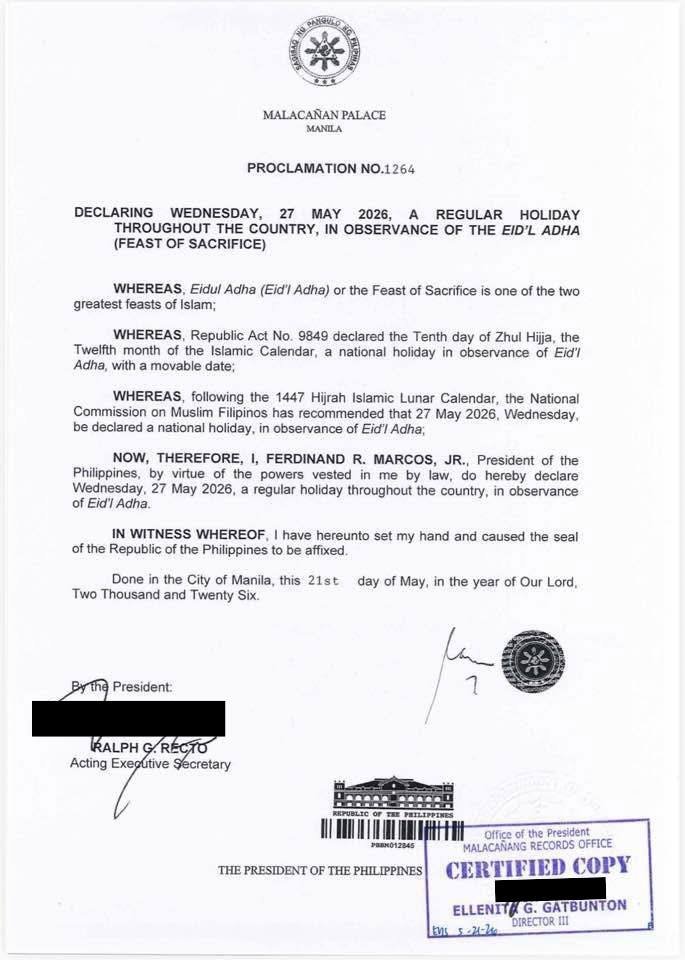
The short answer: Yes, but the exact date is not yet officially declared.
In the Philippines, Eid al-Adha is observed as a regular holiday under Republic Act No. 9849. However, the specific date each year is announced by Malacañang, based on the recommendation of the National Commission on Muslim Filipinos, and in accordance with the Islamic lunar calendar.
For 2026, Eid al-Adha is expected to fall around late May 2026, but this remains subject to moon sighting and official proclamation.
Eid al-Adha, also known as the “Festival of Sacrifice,” is one of the most important Islamic celebrations. It commemorates the willingness of Ibrahim (Abraham) to sacrifice his son in obedience to God, symbolizing faith, devotion, and compassion. It is a time of prayer, charity, and unity among Muslim communities.
While the exact 2026 date is still pending, Filipinos can expect that Eid al-Adha will once again be formally recognized as a regular holiday, reinforcing the country’s respect for religious diversity and cultural inclusion.

As one of the most significant Islamic holidays, many Filipinos are wondering: When will Eid al-Adha be in 2026? and What are the latest updates about its observance in the Philippines?
Eid al-Adha, also known as the “Feast of Sacrifice,” commemorates the devotion and faith of Prophet Ibrahim and is widely celebrated among Muslim communities in the country. This festival serves as a reminder of selflessness, obedience, and gratitude to Allah. It is also a time for strengthening communal bonds, as families and friends gather for prayers, feasts, and acts of charity. In the Philippines, where a significant Muslim population resides particularly in Mindanao the holiday is deeply ingrained in cultural traditions and is recognized as a national holiday under Republic Act No. 9849.
For 2026, Eid al-Adha is expected to fall around late May 2026, based on astronomical calculations. However, since the Islamic calendar follows the lunar cycle, the actual date may change depending on the sighting of the moon, which determines the start of the month of Dhu al-Hijjah. The National Commission on Muslim Filipinos, along with religious scholars, will confirm the official date, which will then be formally declared by Malacañang.
Traditionally, moon sighting committees in various Islamic countries observe the crescent moon to confirm the start of Dhu al-Hijjah, the 12th month of the Islamic calendar. Since the date of Eid al-Adha varies globally, Filipino Muslims eagerly await official announcements from religious authorities and the government to prepare for their celebrations.
Eid al-Adha in 2025 was officially observed on Friday, June 6, 2025, following the declaration of Malacañang, based on the recommendation of the National Commission on Muslim Filipinos.
In accordance with Republic Act No. 9849, the occasion was recognized as a regular holiday throughout the Philippines, allowing Muslim Filipinos to fully observe this sacred celebration.
Eid al-Adha, also known as the “Feast of Sacrifice,” commemorates the faith and devotion of Prophet Ibrahim. During the 2025 observance, Muslim communities across the country especially in Mindanao gathered for Eid prayers, performed acts of sacrifice, and shared meals with family, friends, and those in need.
The celebration emphasized the values of faith, generosity, and unity, with many engaging in charitable acts and community gatherings. It also reinforced the Philippines’ ongoing commitment to religious inclusivity and cultural respect, recognizing the importance of Islamic traditions within the nation’s diverse society.
Eid al-Adha is a regular holiday in the Philippines as declared under Republic Act No. 9849. Each year, the President issues an official proclamation confirming the exact date based on recommendations from the NCMF. As of now, the government has announced that June 6, 2025 is official holiday date for 2025.
Eid al-Adha is a time for prayer, reflection, and acts of charity. The key traditions of the celebration include:
Special morning prayers known as Salat al-Eid are performed in mosques and open fields across the country. In major cities like Manila, Marawi, and Cotabato, thousands of worshippers gather in large venues to participate in the solemn prayer.
Muslims who can afford it perform the ritual sacrifice of livestock such as cows, goats, or sheep. The meat is then distributed among family, friends, and those in need. This act symbolizes obedience to God and generosity towards the less fortunate.
As part of the Qurbani tradition, a portion of the sacrificed meat is given to the less fortunate to ensure everyone can partake in the celebration. Many Islamic organizations and local communities organize meat distribution programs for impoverished families.
Filipino Muslim families prepare special meals featuring traditional dishes like Beef Kulma, Randang, and Piyanggang Manok to share with loved ones. It is also common for families to visit relatives and friends, strengthening bonds and fostering a sense of community.
For those who are financially and physically able, performing the Hajj pilgrimage to Mecca is a significant part of Eid al-Adha observance. Many Filipino Muslims who have completed Hajj host homecoming celebrations to share their experiences and express gratitude for fulfilling this religious duty.
As of now, there is no official government announcement yet declaring the exact date of Eid al-Adha 2026 as a regular holiday. The official proclamation will be issued by Malacañang, based on the recommendation of the National Commission on Muslim Filipinos.
Eid al-Adha is expected to fall around late May 2026, based on astronomical calculations. However, since the Islamic calendar follows the lunar cycle, the final date will still depend on the actual sighting of the moon.
Once officially declared, Eid al-Adha will be observed as a regular holiday in accordance with Republic Act No. 9849. This important occasion remains a time for reflection, sacrifice, and unity within the Muslim community.
Stay tuned for official updates regarding this significant celebration. Whether you are observing or learning about different cultures, Eid al-Adha continues to highlight the values of faith, generosity, and togetherness.
While Eid al-Adha 2026 is expected to be observed around late May 2026 and will be recognized as a regular holiday in the Philippines under Republic Act No. 9849, the official date is still pending declaration by Malacañang.
Despite this, Light of Love Events Place will continue to welcome guests for their most special occasions. Whether you’re planning a wedding, birthday, corporate event, or any celebration, Light of Love Events Place offers stunning venues and a dedicated team to make your event truly unforgettable.
Stay updated on the official holiday announcement and enjoy this meaningful celebration with family and loved ones. For bookings and inquiries, feel free to contact Light of Love Events Place we’re here to make your moments shine!
For more information, you can reach us at: